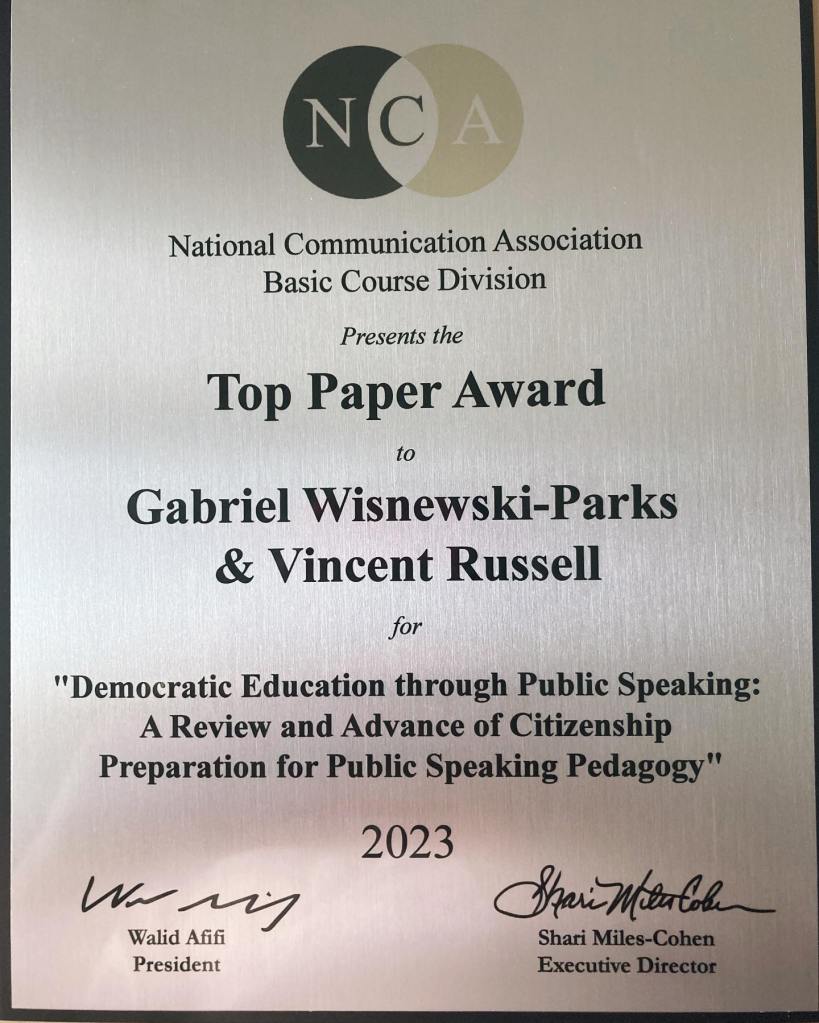
Gabe’s scholarship is globally recognized and has won awards from The National Communication Association and the Carolinas Communication Association. His research is featured in books and journals including The Routledge Handbook of Public Speaking Research and Theory, Business & Professional Communication Quarterly, and Rhetoric of Masculinity: Male Body Image, Media, and Gender Role Stress/Conflict. Gabe has experience peer-reviewing for outlets including the International Journal of Communication and Sex Roles.


As a communication researcher, Gabriel investigates two main areas of inquiry:
(1) The roles social media influencers and platforms play in shaping public discourse. Specifically, the ways social media shapes communication around democracy and institutional trust, and discourse on masculinity and gender-related issues.
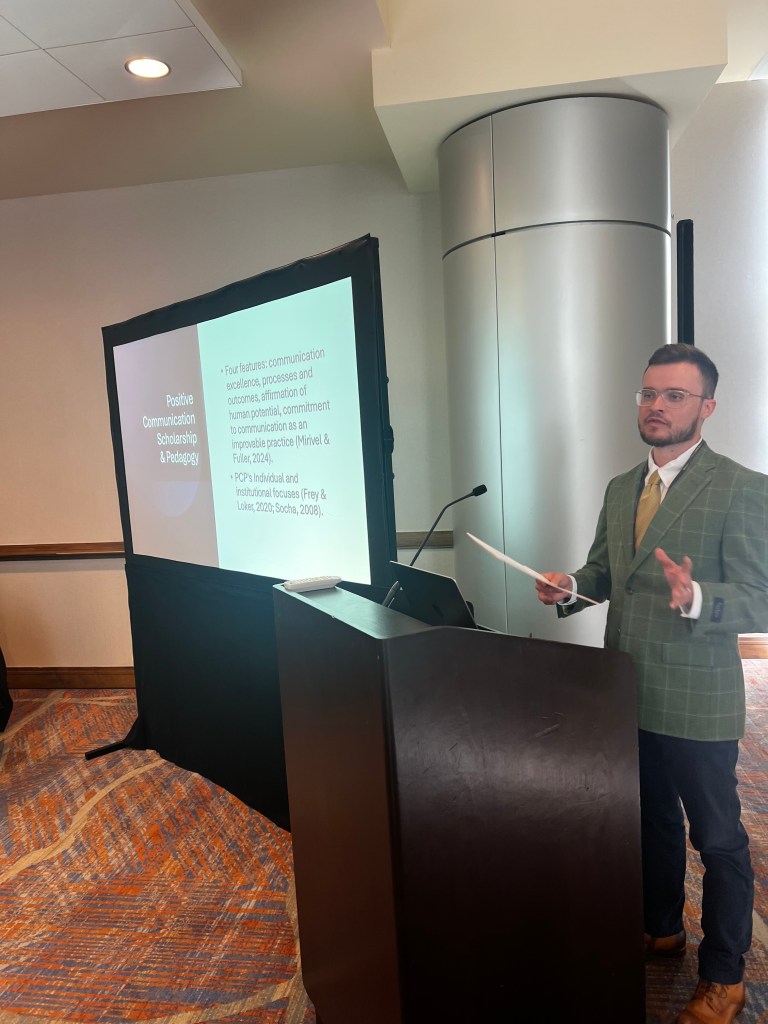
(2) Critical perspectives on education and pedagogy. Specifically, how communication educators can teach in ways that foster civic engagement and democratic practice.

Samples of recent scholarly teaching and research projects below.
My latest article on the BeReal app, for Flow Journal’s new Special Issue.
Interview with CNN journalist, Zach Wasser, about the podcaster, Joe Rogan, and Gabe’s research on the role of social media influencers in political discourse.
https://www.cnn.com/videos/business/2022/02/09/joe-rogan-popularity-zw-orig.cnn-business
New Media & Masculinity Book Chapter
Online influencers and charismatic content creators often present their audiences with narratives about identity crises, and then pitch them over-simplified, unrealistic, or otherwise ideological solutions. In our co-authored book chapter, Daniel Russo (UNC Chapel Hill), Jenni Simon (UNC Greensboro) and myself explore how new media influencers use branding techniques and other persuasive tools to sell their male audiences stories about being ‘men in an age of crisis’. We combine Gender Role Stress Conflict theory from psychology with rhetorical framing analysis to investigate some of the internet’s most popular persuasive personalities. Competing paradigms of masculinity floating around the internet present young men (in particular) with conflicting narratives for how to be a man. At the same time, young men are given conflicting advice on how to address various social and political problems, depending on how their respective, trusted internet personalities articulate those problems for them. Enriching our cultural knowledge of how people deal with psychological stress from the frequent clash between gendered ideals and lived realities, the chapter appears as part of Donnalyn Pompper’s edited collection on the rhetoric of masculinity.

The Rise and Fall of “The Intellectual Dark Web.” (Article for Southern Communication Journal.)
In my 2020 rhetorical analysis of the Intellectual Dark Web (IDW) in Southern Communication Journal, I argued that the competing motivations and conflicting narratives of this network of political influencers boosted their credibility with audiences alienated from institutional media and politics. The “group” sold its audiences on the idea that they offered the public real tools for challenging “mainstream” media perspectives on politics and the news. In their heyday (arguably now over), the IDW branded themselves as “the reasonable thinkers,” the “adults in the room” of public discourse. But I argued that they never actually provided audiences with any unique or subversive ways of thinking reasonably about politics. Many public figures associated with this group–Jordan Peterson, Ben Shapiro, Sam Harris, the Weinstein bros–continue to have influence in public discourse, despite their IDW brand seeming to have waned. Having published this five years ago now, as my debut research, my own thoughts as a researcher and as a voter have evolved. While they are not at the heart of the internet cultural zeitgeist as they once were, I think their impact and their style continues to be felt, particularly when it comes to conspiracy theorist discourse. Check out the article here.

 Gabriel Wisnewski-Parks